DIVERSITY, EQUITY, AND INCLUSION
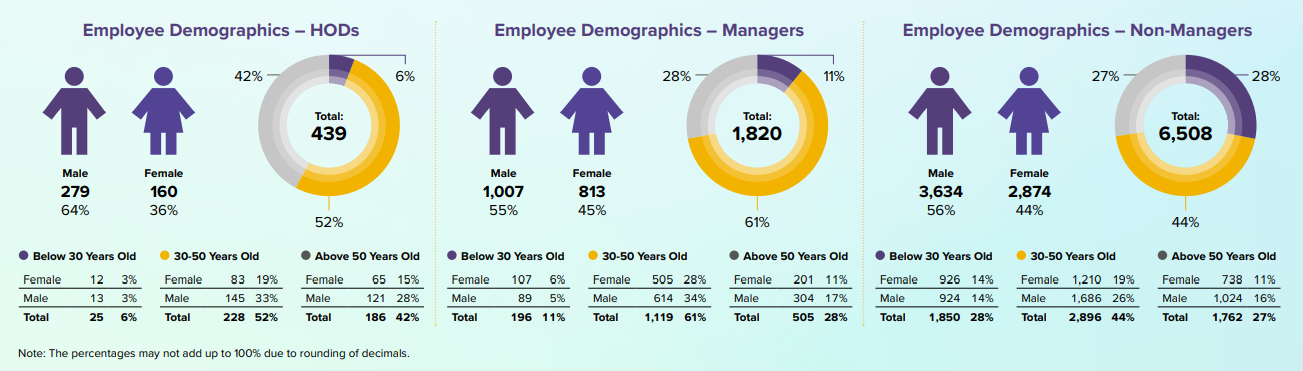
Diversity, Equity and Inclusion (DEI) practices are crucial to ensure a diverse range of perspectives, enhance employee engagement and foster innovation. At CDL Group, women make up a significant 45% of our global workforce, representing 40% of our HODs. At the Company’s corporate office, women make up 68% of our workforce and 45% of our HODs. The Group also has a diversified workforce across all age groups.
Employee Demographics – Breakdown of Global Workforce according to Gender and Management Positions
| Employee type | Total no. of employees | Total no. of female employees | Total no. of male employees | % of females |
| Total workforce | 9,546 | 4,329 | 5,217 | 45% |
| Junior Management | 1,075 | 453 | 622 | 42% |
| Middle Management | 1,227 | 549 | 678 | 45% |
| Senior Management | 107 | 39 | 68 | 36% |
| Revenue-generating departments | 4,197 | 1,824 | 2,373 | 43% |
| STEM | 1,104 | 168 | 936 | 15% |
CDL DIVERSITY AND INCLUSION TASK FORCE
Creating and expanding opportunities for women are fundamental to the Group’s sustainable growth and beneficial to society. The Company’s Diversity and Inclusion Task Force was established in 2017 to promote diversity and inclusion within our workplace and the wider community. Under the leadership of CDL’s Group CEO, the Task Force is co-chaired by the Company’s Sustainability and the HR departments.
PUBLIC COMMITMENT TO WOMEN EMPOWERMENT
In 2017, CDL’s Group CEO, Sherman Kwek, joined over 1,600 leaders globally in pledging CDL’s support for the Women’s Empowerment Principles. Developed through a partnership between the UN Women and UNGC, the principles offer practical guidance to the private sector on how to empower women in the workplace, marketplace and community. In 2022, CDL’s Chief Sustainability Officer (CSO), Esther An, became an advocate for the G20 Alliance for Empowerment and Progression of Women’s Economic Representation. The G20 Empower aims to accelerate women’s leadership and empowerment in the private sector.
RACIAL AND DISABILITY INCLUSION
The Group embraces an inclusive workplace with a multi-racial workforce from diverse backgrounds globally. Where possible, we also provide fair employment opportunities for the less physically-abled. As of end-2025, the Company has one wheelchair-bound employee who has been employed for 17 years.
RACIAL DIVERSITY
CDL Group’s breakdown of global workforce according to ethnicity
| Ethnic group | Total no. of employees | No. of employees in management (including junior, middle and senior management positions) | ||
| Asian | 6,589 | 69% | 1,880 | 79% |
| Caucasian | 1,421 | 15% | 377 | 16% |
| Hispanic/Latino | 328 | 3% | 34 | 1% |
| African American | 119 | 1% | 10 | 0% |
| Others | 827 | 9% | 71 | 3% |
| Note: | |
| The percentages may not add up to 100% due to rounding of decimals. |
ANTI-BULLYING AND ANTI-HARASSMENT
The CDL Workplace Anti-Harassment and Anti- Bullying Policy communicates the Company’s stance for all employees to be treated with respect and dignity. No employee shall be subject to any physical, psychological, verbal or sexual abuse. The Company’s employees are encouraged to be culturally sensitive, tolerant and respectful towards one another at all times. This policy also deals with incidents involving external customers and stakeholders who conduct themselves in a manner that constitutes harassment, within and beyond company premises. To reinforce our stance on anti-harassment and anti-bullying, a compulsory workshop on professional workplace boundaries was launched in January 2021 for all staff, including a session for management. In 2025, the Group recorded zero cases of harassment involving any member of our workforce.
FAIR AND COMPETITIVE REMUNERATION
Fair and competitive remuneration attracts and retains talents to build strong human and organisational capital, enabling the Group’s continued and robust business growth. Aligned with internal parity and market benchmarks, the Group’s equitable remuneration packages are based on employees’ performance and their scope of work.
Employee Performance Management System
The Group uses a well-structured and open annual performance appraisal system, which is reviewed and enhanced periodically to encourage two-way feedback between employees and their reporting officers. The Group utilises a range of performance appraisals methods, including:
- Management by objectives – systematic use of agreed measurable targets by line superior,
- Multi-dimensional performance appraisal
- Team-based performance appraisal
- Formal comparative ranking of employees within one employee category. 100% of the Group’s employees are appraised using one or more of these performance appraisal methods. Appraisals are conducted on a yearly basis.
Pay Parity
A fair and inclusive workplace is one where employees are remunerated equally for the same role, regardless of gender. CDL Group’s breakdown of our global workforce according to gender pay is as follows:
| Gender pay gap across employee categories | Mean salary of female employees to male employees1 |
| Non-management | 103% |
| Executive | 101% |
| Management | 90% |
| Gender pay gap | Mean salary of female employees to male employees2 |
| Mean gender pay gap | 99% |
| Median gender pay gap | 103% |
| Mean bonus gap | 102% |
| Median bonus gap | 90% |
| 1 | Calculated as the mean salary of female staff over the mean salary of male staff. Executives: Executives to Assistant Vice Presidents, and secretaries; Non-management: officer grades and below; Management: Vice Presidents and above. |
| 2 | Calculated using bonus earned in FY2024 and received in FY2025. Computation of FY2025’s bonus will only be available in 1H 2026. |
Competitive Remuneration
The Group conducts annual remuneration reviews to ensure our employees can cope with the rising cost of living. In addition, we conduct market surveys, peer benchmarking exercises and comply with minimum wage standards within the respective jurisdictions in which we operate, where applicable, to ensure that our compensation practices remain competitive. Remuneration is recommended by the Company’s HR department and approved by the Remuneration Committee, which comprises members of the Company’s Board. Salary benchmarks against market surveys are conducted to ensure the relevance of the Company’s salaries with the industry and overall market. An external consultancy firm is engaged biennially to conduct an Employee Engagement Survey for employees’ feedback, including their perception of the Company’s remuneration and reward system.
Employee Well-being
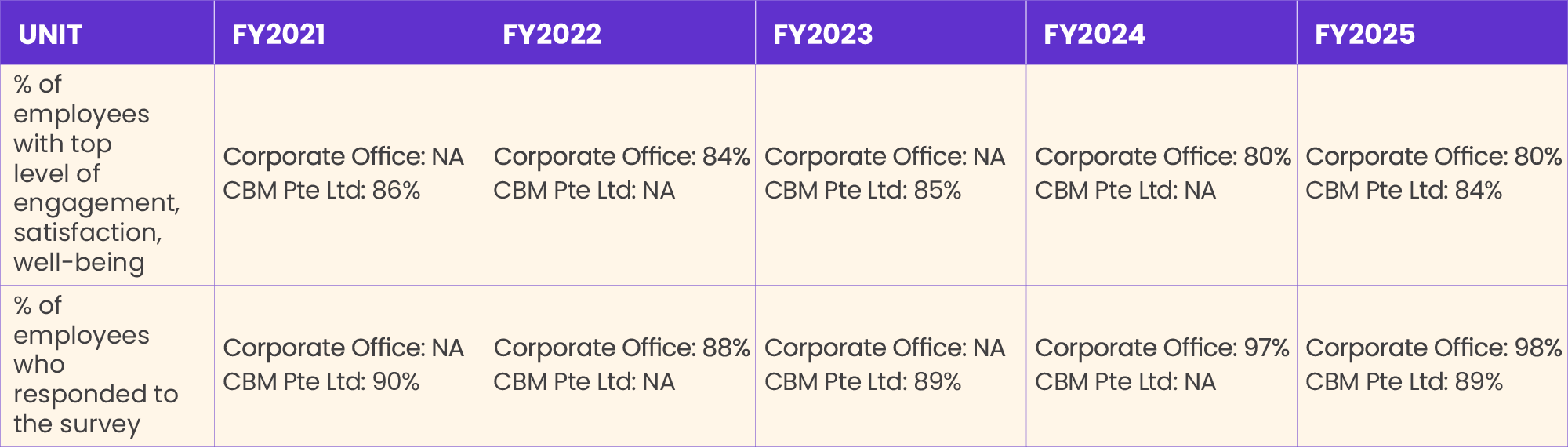
Biennial employee engagement surveys (EES) are conducted by the Company’s corporate office and CBM Pte Ltd. An Employee Engagement Pulse Survey (EEPS) is held by our corporate office every alternate year from the EES. Last held in 2025, the Company’s EEPS engagement score was 80%, with a participation rate of 98%. CBM Pte Ltd last held its employee engagement survey in 2025, achieving an engagement score of 84%, with a participation rate of 89%. Survey questions cover areas such as wellbeing of employees, job motivation and satisfaction, and work productivity.
Environmental, Social and Governance (ESG)-linked Remuneration
Incorporating ESG issues into executive management goals and incentive schemes promotes greater recognition and accountability in our sustainability practices. Since 2015, the Company has established stronger linkages between employee and executive remuneration and our ESG performance. Performance indicators that are aligned with global standards such as ISO 26000, ISO 14001, GRI Standards, UN Sustainable Development Goals (SDGs) and others have been incorporated in the individual goals-setting of all employees, including the Company’s ExCo and senior management.
CDL links executive remuneration to sustainability through both the Short-Term Incentive (STI) and the Long-Term Incentive (LTI) frameworks to reinforce accountability for ESG outcomes alongside financial performance.
Under the STI, ESG forms a defined component of the balanced scorecard for ExCo members, with 30% of ExCo remuneration contingent on ESG performance, comprising 5% Environmental, 15% Social, and 10% Governance targets. The Environmental dimension focuses on sustainability initiatives linked to the Group’s Net Zero Carbon roadmap, the Social dimension covers staff engagement, retention, and talent outcomes, and the Governance dimension measures enterprise risk management effectiveness as well as compliance and audit performance. These ESG indicators are supported by measurable KPIs that are cascaded to Heads of Department (HODs) who report to the ExCo. This ensures clear ownership and accountability at every level of the organisation, with performance assessed against Board approved annual targets.
Benefits And Welfare
We provide comprehensive welfare and benefits schemes, including, but not limited to, insurance coverage, medical and dental benefits for our fulltime employees. Part-time employees are entitled to similar benefits on either a full- or pro-rated basis. This helps to promote a conducive environment should employees decide to take on part-time arrangements to manage their personal needs.
Pro-family Benefits
The Group adopts welfare practices in line with the respective pro-family legislations stipulated within each jurisdiction that we operate in. Across the Group, we provide paid maternity leave between 12 and 52 weeks, as well as paid paternity leave between two and 12 weeks, depending on the country of operation. The Group also provides eligible employees with up to eight days of childcare leave and extended childcare leave, where applicable. For employees based in Singapore, both female and male employees are entitled to an additional 6-week shared parental leave from 1 April 2025.
The Group also provides employees with Family Event Leave or equivalent, which can be utilised to attend to family matters. This ranges from three days to 12 weeks, depending on the jurisdiction in which we operate. In 2025, 50 eligible female employees across the Group utilised their maternity benefits and 23 returned to work after their maternity leave. 56 eligible male employees utilised their paternity leave.3
| 3 | This does not include M&C (Europe/United Kingdom) and M&C (United States). |
Flexible Work Arrangements
The Group offers flexible work arrangements, where appropriate, providing support for employees who need to manage work responsibilities alongside personal commitments:
- Flexi Time
Staggered Working Hours – employees can opt to start work earlier or later than the official working hours. - Flexi Place
Telecommuting – Employees can work at alternate work locations. - Flexi Load
Part-time Work – Full-time employees can convert to part-time roles while retaining similar benefits as full-time employees on a full- or pro-rated basis.
Flexible Benefits Scheme
Across the Group, all employees are entitled to medical benefits that grant them access to outpatient medical treatment as well as hospital and surgical treatments. The Company provides a Flexible Benefits Scheme for all regular employees, affording them the flexibility to explore a range of health and wellness options covered under the Company’s health insurance plan and select those that best suits their health needs and stage of life. Under this scheme, family-related expenses and insurance coverage are extended to all regular employees of the Company, including infant and childcare expenses, as well as medical and insurance coverage for family.
With effect from January 2026, the Company enhanced our executive health screening benefit by extending eligibility to employees across all job grades.
Pension Scheme and Contributions
The Group adheres to the respective social security contributions or pension plan obligations of the countries we operate in, where possible. In Singapore, the Central Provident Fund (CPF) is a comprehensive social security savings plan introduced by the Singapore Government to enforce savings by salaried workers, including Permanent Residents, for a more secure retirement. CPF funds can be used in several schemes including retirement, healthcare, housing and investment. Under the CPF scheme, for the Group’s staff based in Singapore, we make monthly contributions to the individual’s CPF accounts in accordance with Singapore’s statutory requirements.