EMBODIED CARBON
Embodied Carbon Emissions From Construction Materials
As part of our renewed SBTi-validated GHG reduction targets, the Group has committed to reduce the embodied carbon1 of our building materials by 41% compared to 2016 baseline by 2030. Furthermore, we anticipate carbon-intensive construction materials, such as steel and cement, to become increasingly costly, and have begun planning for usage of more sustainable alternatives in the future. We also monitor and report the embodied carbon performance of our projects against our SBTi-validated targets. This addresses the Group’s scope 3 emissions and wider supply chain management strategy.
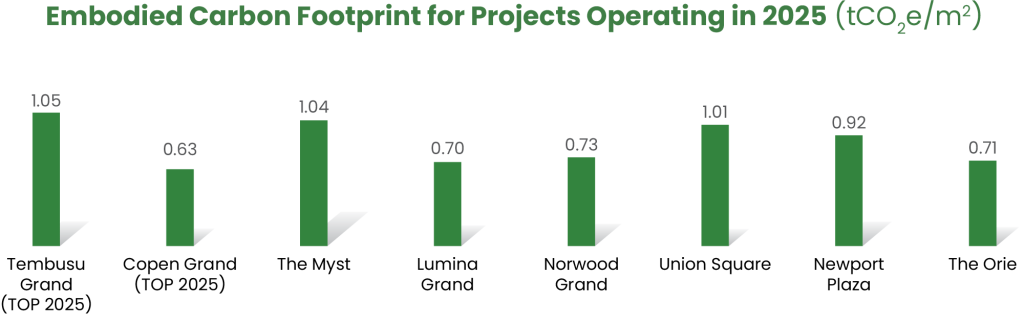
An interim 2025 target of 25% or higher reduction in embodied carbon of building materials was set, based on the relevant building projects’ contractual obligations. We track the performance of these projects against the current interim target2 to map our phased progress towards the 2030 SBTivalidated target of 41% reduction. The Group obtained Temporary Occupation Permit (TOP) for Copen Grand and Tembusu Grand in 2025 and achieved a total of 50% carbon reduction amounting to a carbon intensity of 0.83 tCO2e/m2.
Managing Impact Of Top Building Materials
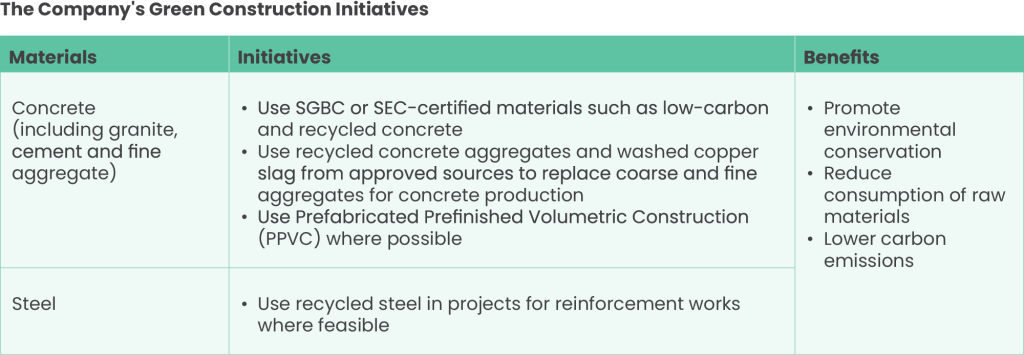
With cement and steel production accounting for approximately 7% and 7–9% of global carbon emissions respectively, reducing reliance on these materials is critical. We adopt a circular economy approach across our developments, prioritising recycled materials such as recycled steel and concrete, promoting lower-carbon alternatives and exploring innovative construction methods to support our transition to net-zero.
Since 2016, the Group has been tracking and reporting the top five building materials and embodied carbon intensities of the construction materials used in our property development to determine the wider carbon lifecycle impact of our projects. The embodied carbon emission intensities for our projects have been derived using BCA’s Carbon Calculator, based on the type and quantity of construction materials used. Since 2024, our top five building materials have been reported based on its equivalent tonnage of embodied carbon emission in tCO2e.
| 1 | The final embodied carbon refers to the carbon dioxide equivalent or GHG emissions associated with the non-operational phase of a building and has become an increasingly important area for the built environment sector to address. It includes emissions caused by extraction, manufacturing, transportation, assembly, maintenance, replacement, deconstruction, disposal and end-of-life aspects of the materials and systems that make up a building. |
| 2 | Based on the lifecycle of the Group’s project developments, the final embodied carbon data for building materials is only available upon TOP attainment. |

| Note | |
| • | Top building materials for 2025 pertain to one project which attained TOP and eight projects that were still under development. Figures reported were hence based on the project design stage. |
| Notes | |
| • | Copen Grand and Tembusu Grand achieved TOP in 2025 and the figures have been amended to reflect the actual embodied carbon intensity. |
| • | Apart from Copen Grand and Tembusu Grand, the remaining projects are based on design stage embodied carbon calculation. The final embodied carbon emissions will be verified upon the respective projects’ completion. |
| • | Due to ongoing verification, Zyon Grand’s embodied carbon intensity will be reported in the following ISR. |